I woke just after 3am and didn’t sleep again – not a terribly unusual experience before a big race, but I’d had a nap yesterday afternoon and gone to bed in good time, so it wasn’t likely to be consequential. I had to get up in good time anyway to have my porridge for breakfast and make sure everything was ready – on me, in the bag for before the race, and in the bag for after the race.
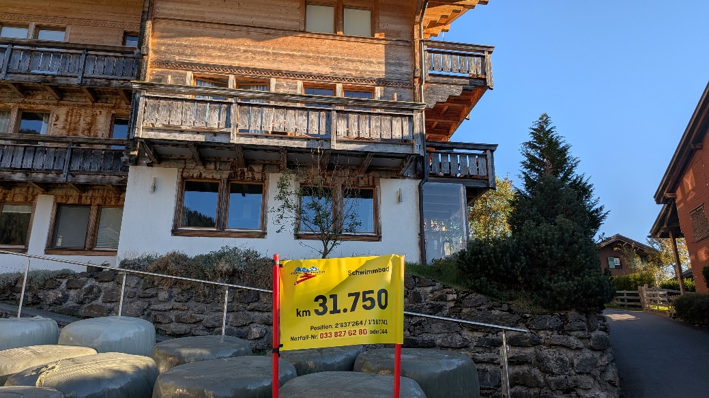
We left the apartment at km 31.75 on the course, and walked down to Wengen railway station (at about km 30.7 on the course) to catch the 0641 train, changing at Lauterbrunnen (about km 20.5 on the course), reaching Interlaken Ost (about km 4 on the course).
We arrived at 0724 and I went to the loo at the station, assuming they would be very busy near the start, then we walked into town. After queuing for quite a while to drop off my bag with clothes and drinks for afterwards, to be carried by train and cable car for me to Eigergletscher station ready for my arrival this afternoon, I parted from Dad and got myself into the start zone.
There had been the usual focus in communications from the race organisers, typical of bigger races, stressing the importance of starting in the correct block based on predicted finish time – but I’d entered in February, had no idea what finish time I’d put down then, and could find no evidence of it in the online account, entry confirmation emails, or on the race number. In any case, despite the firm messaging pre-race, there appeared to be no enforcement either, so I got myself into block 5, nominally with a 5h50 to 6h10 finish time, but confusingly I was also between the 6 and 6.5 hour signs, and was thus able to advise Dad to expect me between those respective pace-makers with flags.
There was a performance by alphorn-players, a runner who arrived by paragliding into the park alongside me, and a playing of the Swiss national anthem – great to see the national confidence despite there being 76 nationalities taking place in the race. And soon it was the start. It took me just over three minutes to get to the start line, and I was off – at 567 metres above sea level (567m asl)
As is normal at most larger races, at first it feels like there are too many people and it is hard to run at the desired pace – I prefer the approach of a narrower start arch to impose a pinch-point, so that once through that the runners can spread out more. Here, the start arch was the width of the road, and so with everyone wanting to be underway, the crowds before the line persist after the line.
It shouldn’t really matter, especially in a marathon, and especially in one where my primary objective was to finish safely and (though I had a pace plan) where the time was relatively unimportant. But it is still frustrating not to be able to get going at my natural pace straight away – and to be losing against the pace plan. But by the end of the first kilometre we had all spread out a little and I started chipping away at the deficit from my planned pace. I saw a message from Dad saying he’d gone for the earlier train rather than waiting for me to go past a second time – possibly sensible as there could have been a bit surge of people trying to get the next train 30 minutes later.
As we completed the 3.4km loop of Interlaken and approached the start line for the second time, I was feeling fairly good, and had regained my planned schedule with a good deal of dodging around slower runners, but was then highly conscious of the announcer at the start line urging people inn German and English not to start too quickly and to save themselves for later in the race.
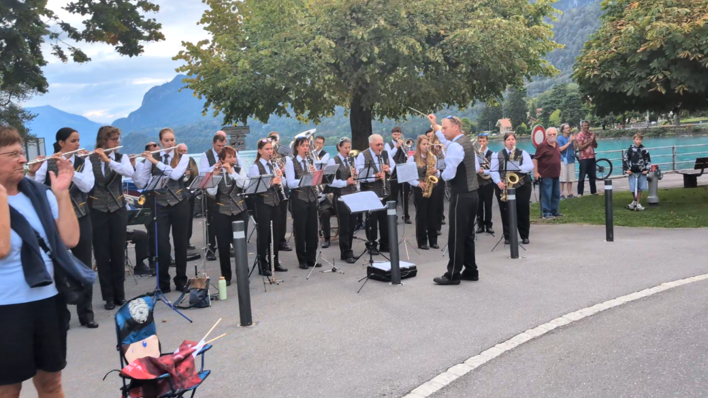
We then ran past the railway station and then out of the centre of town under the bypass bridge, eventually turning right at the waterfront at Bönigen where a band was playing for us, with beautiful views out over Lake Brienz.
The first drinks/aid station was just after 5km, and I took on Sponsor isotonic drink and water. Both the orange and the lemon isotonic were fine, and I took on at least one at every stop. The call of “Iso” (“ee-zo”) became our constant companion as we approached each aid station. As I’ll describe later, I think I put too much faith in the Iso – it does contain some salts, but the volumes we were given in the cups were too small to return anything like the amount of salts that I was sweating out, and I should have been more determined to continue to consume the salt capsules that I’ve found to be a reliable companion for long runs, albeit awkwardly large to consume without briefly pausing for accompanying water.
According to my watch, I was exactly to my schedule, though calculations from Paul on the WhatsApp group suggested I was ahead of target – I was slightly anxious that Paul was right and somehow I was wrong. But I stuck to what the PacePro on my watch said – it has quirks, but I’ve found on the whole that the Garmin PacePro system, once correctly set up, works well for me on my watch. It can throw out oddities when the plotted course isn’t exactly the same as the one on the ground (I suspect the start line might not have been exactly right, accounting for me being suddenly 16 seconds behind initially). And though I was showing as exactly on pace, plus or minus a second, when I reached Wilderswil, my watch suddenly showed me rather more ahead as I moved into the second leg, whereas the retrospective data shows me 26 seconds behind at that point – clearly at most one of those three things can be right.
We passed more crowds in Bönigen centre, including a group ringing some very large cowbells, before emerging into open country for the first time. There were many sights of men and occasionally women relieving themselves – perhaps I missed them but in the entire marathon I saw only one Portaloo or equivalent along the route. I had no need for the toilet between 7.30am at Interlaken Ost station and getting home again at about 4.30pm, so fortunately it didn’t present any challenges to me.
Around this point my left thigh started twinging consistent with a very minor strain, which was not encouraging, but I could do nothing except hope for the best and try not to do anything too dramatic in terms of sudden acceleration which might make it worse. I continued to feel it intermittently for the rest of the day – at least until more serious pain beyond Wengen rather distracted me from it.
We crossed the Lütschine river for the second time, through a covered bridge, and I was almost immediately afterwards passed by the 6-hour pacer – the woman running next to me and I exchanged puzzled glances and then I was pleased that my German could cope with an exchange of remarks about what was he doing there and we reassured each other that we were not going too fast. We moved from tarmac to gravel for the first time as we headed into Wilderswil.
The second aid station was more “Iso”, water and two chunks of banana which worked well and I took on two chunks of banana at the seven aid stations that had banana (plus the finish) and Iso and water (sometimes two of them) at every opportunity, plus Coke at some of the later stations, as well as the 18 jelly babies I carried with me and half a bottle of Mars Milk I got from Dad later on.
There were a total of 15 aid stations along the route, with each one offering a range from just water at four of them, to combinations of the orange and lemon Iso, Coke towards the top, bouillon (soup) in the middle sections, energy bars, energy balls, bananas, three sorts of gels, and cooling sponges. The range of options was far bigger than I’ve experienced anywhere else, and a little confusing, in part because the mixture of options varied somewhat – and led to me accidentally taking on bouillon at one point. And unless you have experience of this brand of energy bar, ball or gel, perhaps not great to experiment during a race – I had decided to make an exception for the Iso. I’d also never drunk Coke during a race, but decided it should be fine, and the relatively small volumes would bring a little energy, but weren’t enough to cause any digestive distress.
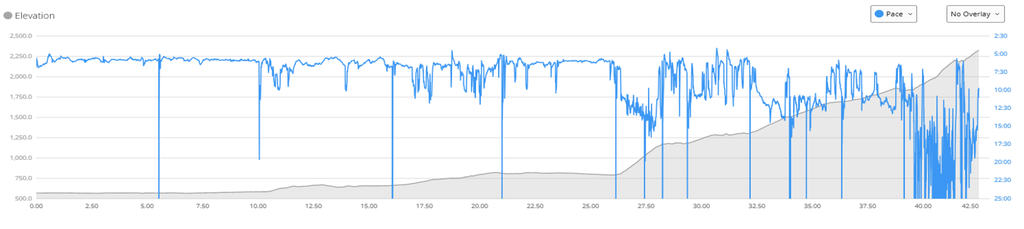
At Wilderswil, there is another covered bridge (588m asl), taking us across the river for the third time, after which was the first hill and my second pacing segment. First goal pace was 5:52/km, reported by my watch as achieved 5:52, though other data were slightly inconsistent with that, but nevertheless I’d made a good start on the level: now for a gentle introduction to the more varied terrain that was to come.
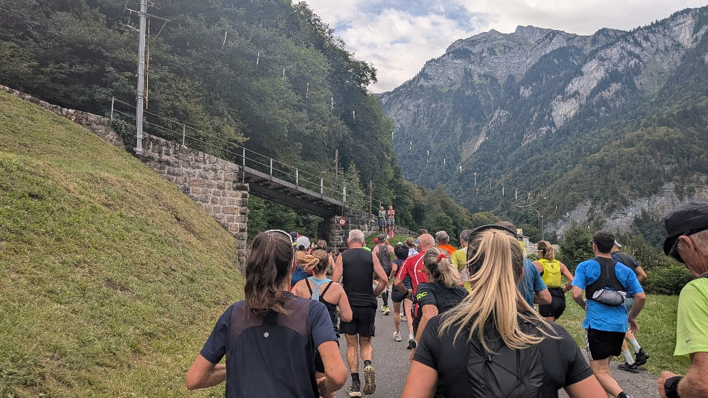
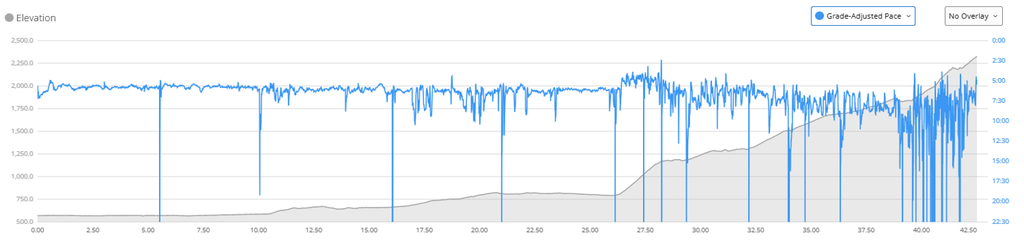
Though I would have had no difficulty in running up it, in my plan to avoid overdoing it too early I mixed walking and running up the hill, but brisk walking was close to the overall target pace of 9:09/km and it seemed bonkers to walk the whole thing when I could easily jog bits and the 1.1km of this segment wasn’t all hill anyway. I ended up with 7:25 pace – was this “too fast” or did it reflect the reality of a sensible effort and an overly conservative planned pace?
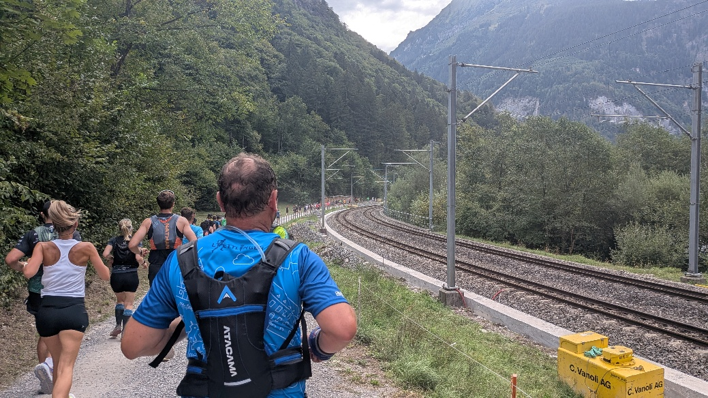
The gained height was almost all lost over the next section which included the village of Gsteigwiler (650m asl) with lots of “Hopp” calls and some more giant cowbells; eventually we descended back to the level of the railway and river (which of course gradually get higher above sea level as we move up the valley away from Interlaken).
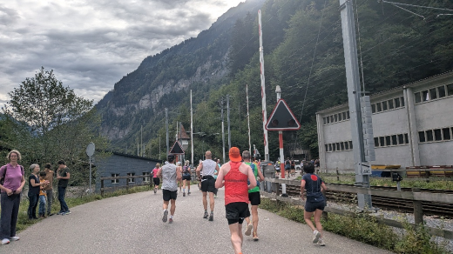
As the route approached Zweilütschinen railway station (652m asl), we crossed over one of the Lütschinen (the Schwartze one coming from the Grindelwald direction) and ran behind the railway maintenance facilities. As I ran towards the level crossing, I was hopeful that I was there in time and that the lights wouldn’t turn red as I neared them, and all was well. I crossed the line at almost exactly 1008 with the train due to arrive at Zweilütschinen at 1009 so I can’t have missed it by much.
Approaching the other railway line as it continued on towards Lauterbrunnen, we turned left, again parallel with the railway line on one of two pure grass sections of the route, lasting perhaps 300 metres, before another aid station, and then it was mostly paths rather than roads from here to Lauterbrunnen.
There were some very pleasant sections through a mixture of woods and more open areas, sometimes close to the rapids of the river turned to a light cloudy colour by its glacial silt, sometimes a little further away, mostly the route being on a very gentle incline to keep up with the river and its many cascades, but some short slightly steeper sections. The further south we progressed up the valley, the more the views of the mountains opened up, along with the iconic views of the near-vertical sides of the Lauterbrunnen valley.
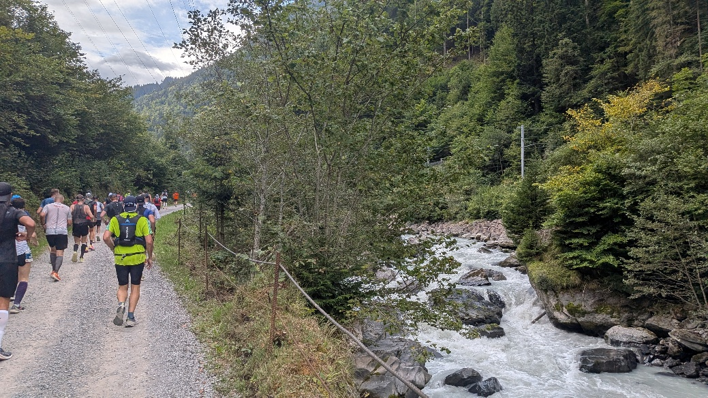
Conscious that I was gaining further on my scheduled time, I made efforts to walk up little inclines, and when I found the time gain reached a round figure, I slowed to a walk for a while, to deliberately slip back a bit, but the subsequent run section always seemed to take me further – it was one step back, two forwards. Paul’s updates implied I was a fair bit further in advance than my watch said, but in either case I needed to be careful to keep energy in reserve after the 26km warm-up for the remaining 16km of the route.
Although I was taking regular photos and short video clips, and uploading most of them to the WhatsApp group, and reading most of the comments on there on my watch when I was in places with easy footing, I suddenly found a message from Dad from nearly an hour ago telling me that he was in a slightly different place at Lauterbrunnen than we’d tentatively planned – it was very helpful to know and I was glad I spotted it in sufficient time. Alerts from WhatsApp on the watch are fine, as if I missed seeing one on the main group, it would be stacked with the next when that alert came in, but an isolated message from elsewhere (such as Dad) was at risk of being missed entirely.
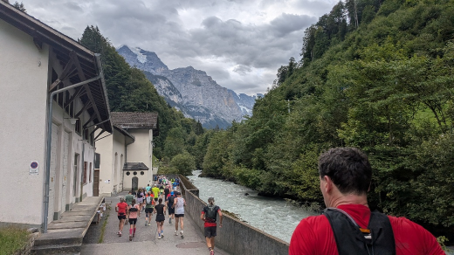
Three more crossings of the river and we turned up the hill towards Lauterbrunnen, heading first under the railway bridge where I saw Dad. He soon after sent a message to say that there were very long queues at the station and so he was going to attempt to get up to Wengen rather than waiting for my return to Lauterbrunnen after my excursion up the valley and back.
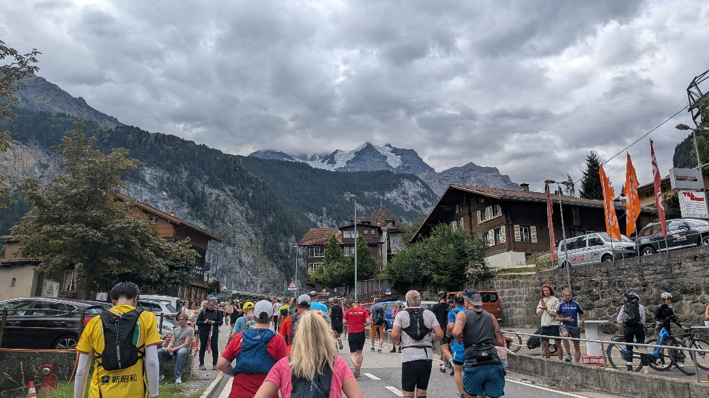
After turning the “zag” of the zig-zag up the hill into Lauterbrunnen centre, I took a photo as I approached Lauterbrunnen railway station (797m asl) and a fellow runner beckoned to me, took my phone to take photos of me – I wasn’t quite sure what he had in mind as the natural angle one sees of most fellow runners is from behind, or just possibly the side, but I turned round and ran backwards so had quite a fun photo of me – and I am in a rare category of people to have run part of the Jungfrau Marathon backwards.
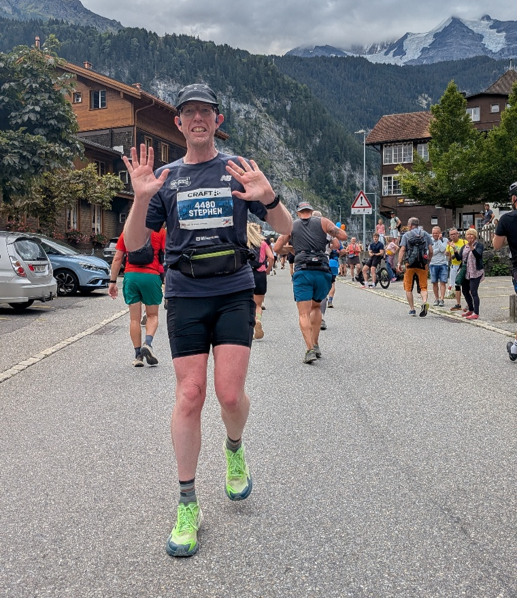
Emerging from Lauterbrunnen for the first time, I passed the half-marathon point, feeling pretty good, and about 5 minutes ahead of schedule according to my watch. As Paul commented, half the distance but only about 15% of the height gain.
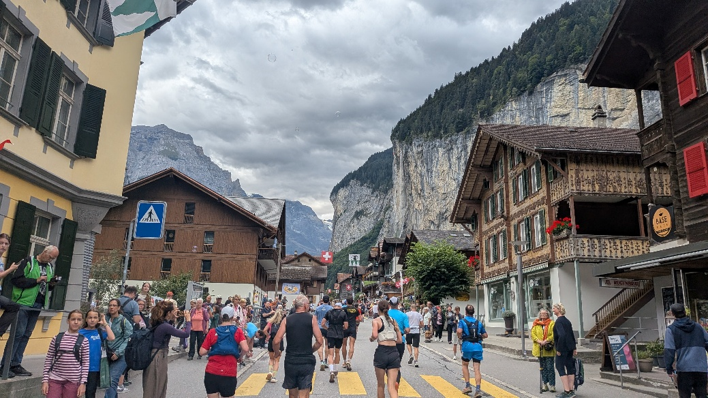
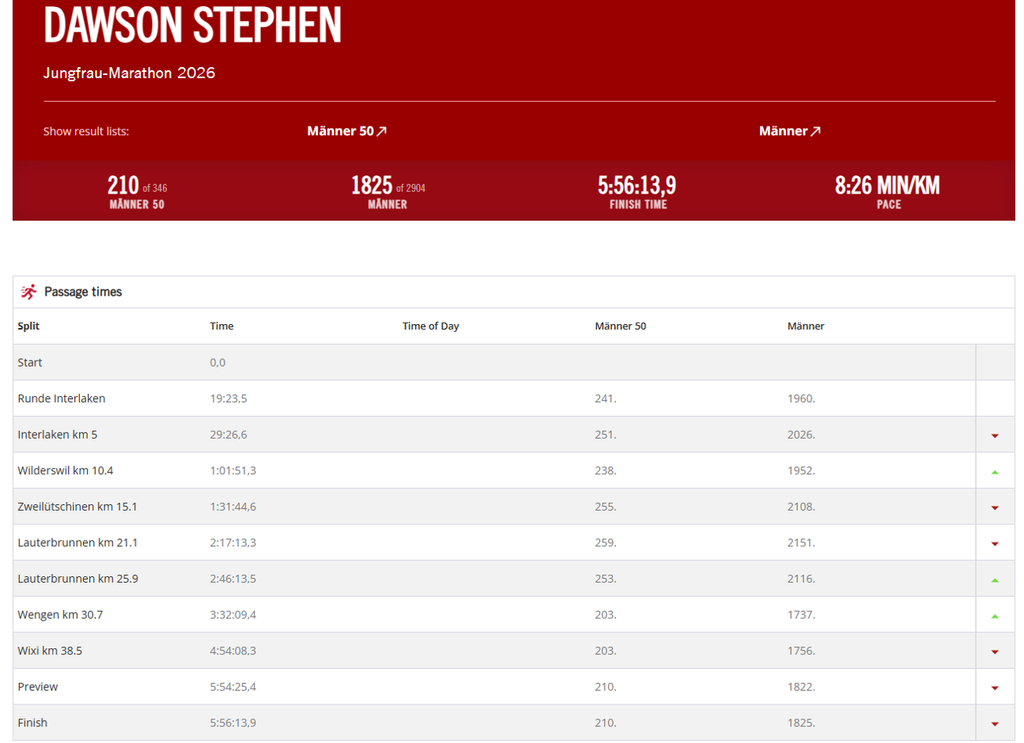
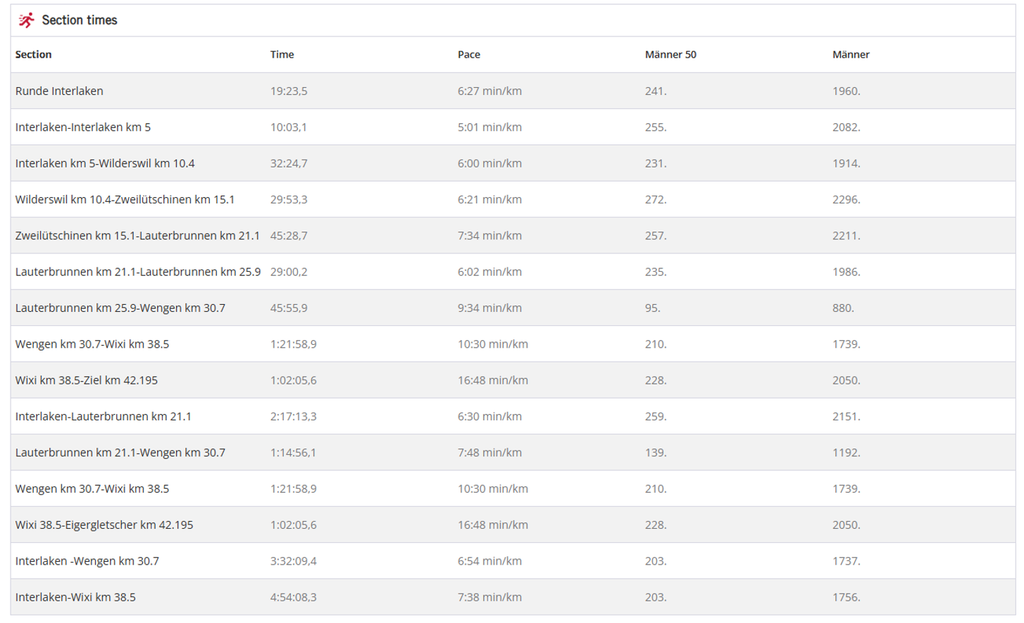
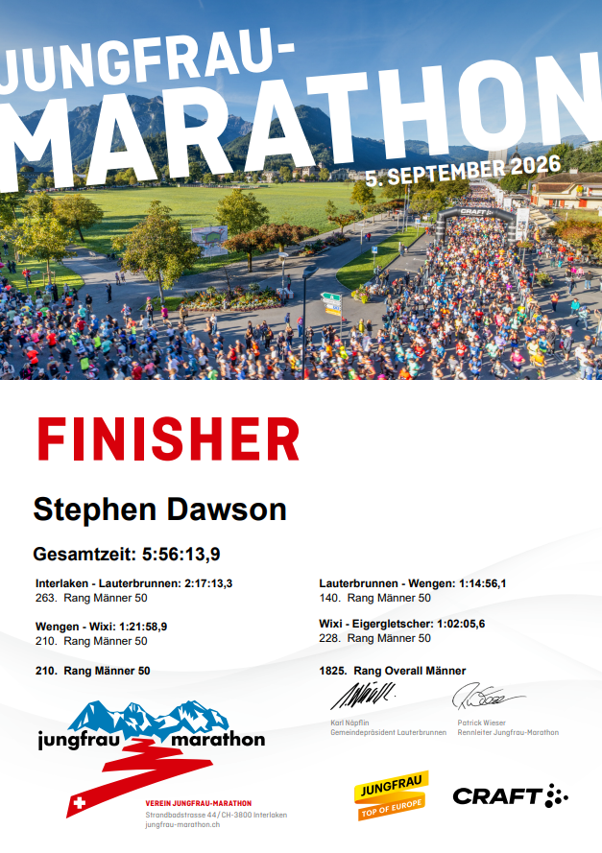
Interestingly, on the section from Wilderswil to the half-marathon point just outside of Lauterbrunnen, I dropped 199 male places. I was deliberately taking it easy, but clearly easier than my fellow runners, and maybe a little too easy – who can say?
Two years ago, I’d walked with Mark this section south past the Staubbachfall waterfall (not currently very impressive after more than a year of below average rainfall) and across the river close to the Trimmelbachfälle waterfalls. After crossing the river for the final time (811m asl), accompanied by some steel drums, we now turned north along the main valley road for a very gently downhill section to restore some energy prior to the start of the big effort.
I turned right away from the river (795m asl) and began what was initially a gentle ascent, then turned right again, steeply uphill. “Now begins the fun” said a runner alongside me – perhaps requiring a redefinition of “fun” but it was certainly the start of the next stage. After a short run on tarmac up the hill, the route bears right onto the zig-zag path up The Wall. While definitions vary on where you draw the lines for start and end, on my pacing plan I had this as 361 metres of ascent in 1.87km, to be done in 37:58. The off-road section started with an “arch” of bricks, echoing “The Wall” name.
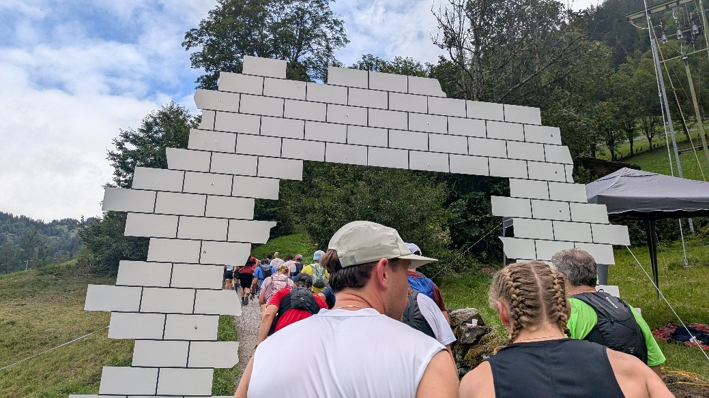
Everyone was walking, but there was a range of paces and styles, and it seemed that my pace was towards the top end of those around me in the 6 to 6.5 hour band, and they spread themselves the width of the path, often with hands on hips to make sure they took up as much space as possible.
I pressed on, not pushing at top pace, but not wanting to dawdle either, gradually making my way through the crowds as the opportunities arose, breaking into the occasional jog from time to time too. I didn’t see a train on the ascent, but did note passing under a bridge on the old (steeper) route of the railway.
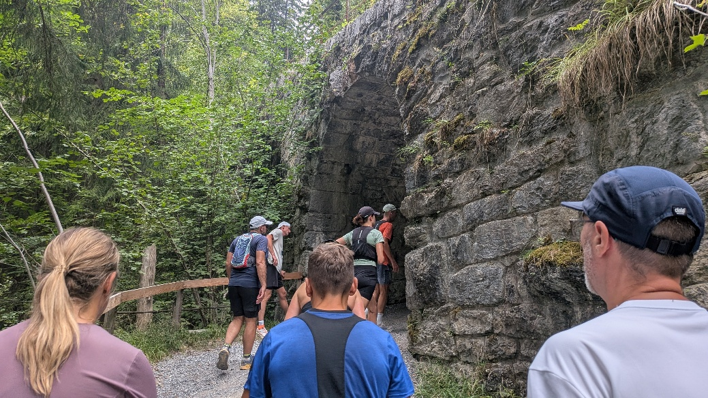
When I emerged from the woods at the top of The Wall proper (1145m asl), passing the first aid and massage point, which was being well used, I’d moved from being 5 minutes ahead of schedule to almost 18 minutes ahead, which was a quite remarkable improvement on the plan, or I suppose demonstrating how cautious and pessimistic the plan had been. Analysis after the race showed that I was 881st of 2903 men in climbing this section, well ahead of my overall position – I don’t think a single person passed me on the ascent, but I passed quite a lot.
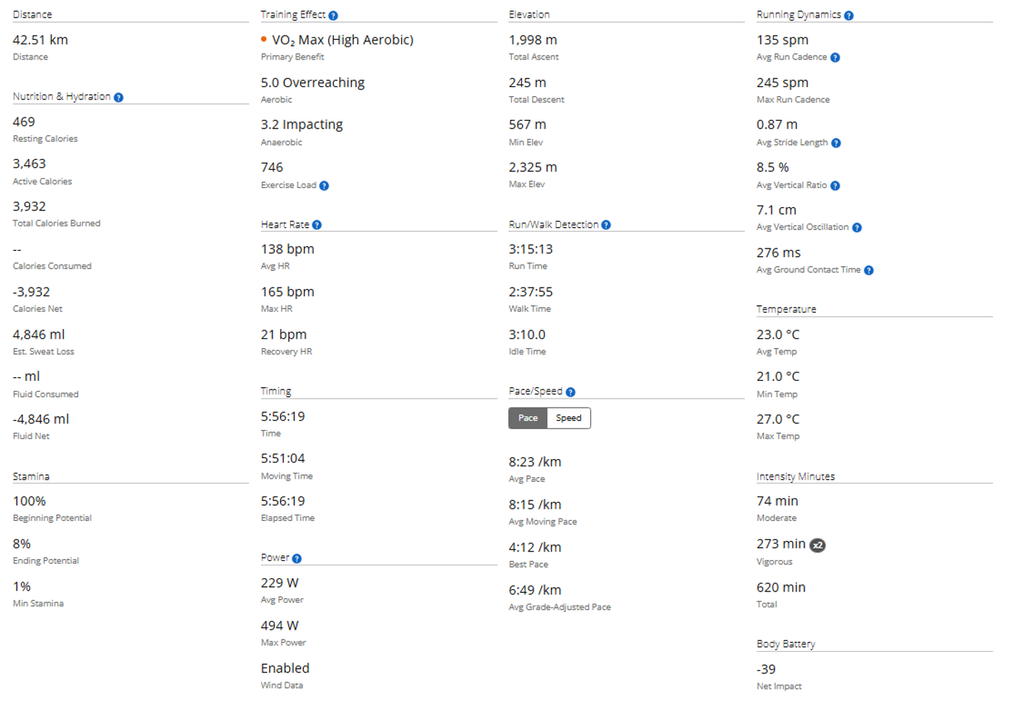
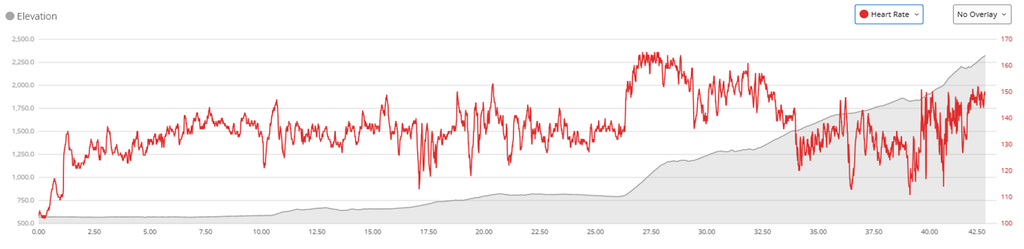
I genuinely don’t feel I over-did it, didn’t kill my legs, though it was the only section where my heart-rate touched 160 bpm during the day. The ascent was steep but not unbearably so, and echoed some of the practice ascents (deliberately so) I’d done in the Lake District, Welsh borders, and Brecon Beacons during my training this year – mostly a relentless fast walk, use of hands on thighs to push down and spread the effort away from just legs, and a willingness to jog where the gradient eased even very briefly. In particular I found I was able to run at the top just as easily as at the bottom.
We then had a downhill section which was delightful, but a little narrow and again full of people who had been too slow for me going up and were now too slow for me going down. I don’t know whether I ended up with the right mix of paces across the hugely varied elevation profiles and terrains of the day, but my mix was certainly different from that of many other people with a similar overall net pace.
By the time I reached Wengen, I’d improved from 2116th man to 1737th, a gain of 379 male places, so probably more than 500 people overall.
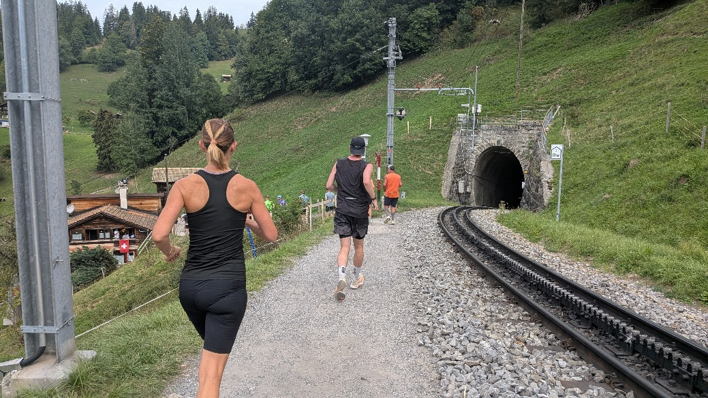
We ran past Wengwald railway station (1180m asl) and the upper portal of the railway tunnel, then doing a loop round to the north of Wengen as we gradually gained height, passing a couple of alphorn players who were taking a brief break as I passed them. The next section Dad and I had walked into Wengen yesterday, but this was quite different with the crowd support including the staff of the hotels in traditional Swiss costume shouting their “Hopp hopp”, the church bell ringing, and me trying to get the right balance of walking and running uphill.
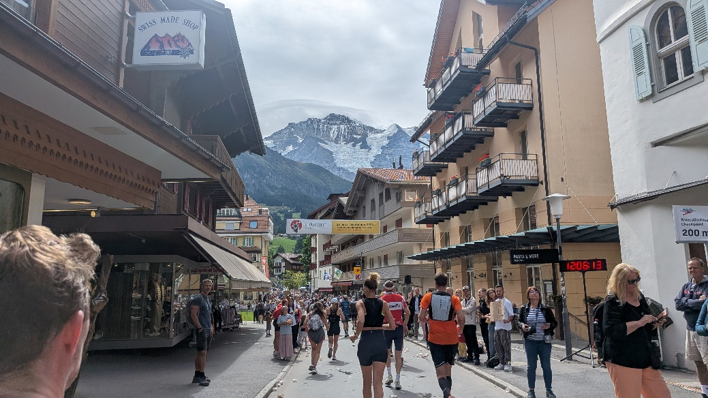
I crested the hill (1290m asl) and then ran down the familiar main street of Wengen, busier than at any point in our visit, and passed the very crowded railway station area, beating the cut-off time (failure to which means being eliminated and a DNF, and – worst of all – no finisher t-shirt) by about 53 minutes.
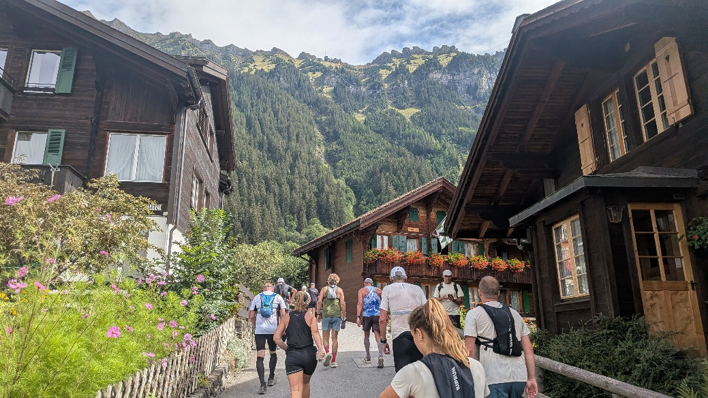
A sharp little climb past a hotel is then followed by a steep little descent which Dad and I had walked on the first evening – I overtook a number of people here and was close to going too fast as it was steeper, on gravel, than I had quite appreciated and I struggled to put the brakes on. Then past the ice-skating rink, the cable car station, and a loop round on a very pleasant path to the east of the village centre. Dad had told me he was near the post-boxes close to the apartment, and as I reached the railway bridge I saw a yellow post box (for posting things), and was anxious that I’d misunderstood him, but looking around I couldn’t see him, and sure enough a couple of hundred metres further I found him outside our apartment next to the mailboxes for those living in the apartments. I stopped for half a bottle of Mars Milk for fluids and energy, then pressed on.
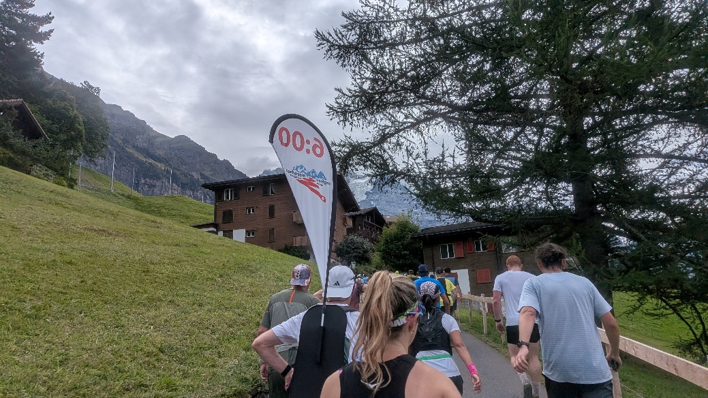
After the undulations of Wengen centre and the steady but moderate climb that had preceded it, now there is the start of a long sustained ascent from Wengen to Wixi, climbing 540 metres over 6.4 km, and the steepest sustained section comes first, the 1.5km to Allmend station with its 191 metres of ascent, albeit with a very welcome aid station part-way, at the end of the last tarmac of the race – gravel roads for about the next 6km or so. Along this ascent to Allmend (1500m asl), I caught and passed the 6-hour pacer with the flag on his back, a remarkable and unexpected moment.
Around 34km, a sudden and intense cramp seized my entire right leg, including thigh, calf and foot, and there was some screaming and hobbling. I feared this could be the end, as even when it died down a little, my leg was stuck almost unbendable, and I pulled it around in a very stiff gait as I struggled to make progress painfully slowly (literally). A couple of fellow runners stopped to see what they could do to help, and suggested sitting or lying down briefly, but I rejected those suggestions as experience shows they are likely to make it worse. I kept moving through the pain, and it gradually eased and I was able to walk more normally.
I think I had become too reliant on the benefits of having the Sponsor “Iso” at every aid station, and it hadn’t been enough – I should have followed my tested salt capsules. In the absence of any fluid, I got three of these large capsules down me as quickly as I could, and vowed to have more when I next had access to fluid.
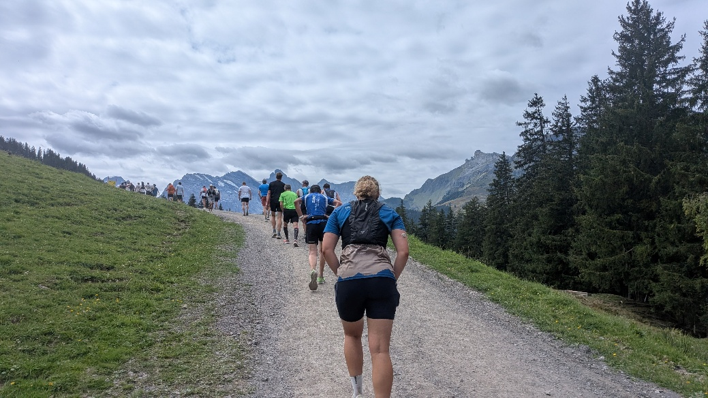
Though my feet in particular continued to cramp slightly, the leg largely stopped and I was able to press on with the brisk uphill walking, and when a more level section came along, broke into a gentle jog, and though I’d lost a little time, it only amounted to falling back by 30 seconds or so over that section, and I had gained a further three minutes on the section up to Allmend railway station so I was still doing well time-wise, though it definitely constrained my running speed for a while as my leg continued to be very tight and I was nervous about recurrence. For the first time in my life (and recalling I’ve now been running for 18 years) I really felt the meaning of having “heavy legs” – they both felt twice as heavy as normal. I’ve had stiff legs, tired legs, achy legs, legs that just don’t want to run any more, but these were definitely heavy.
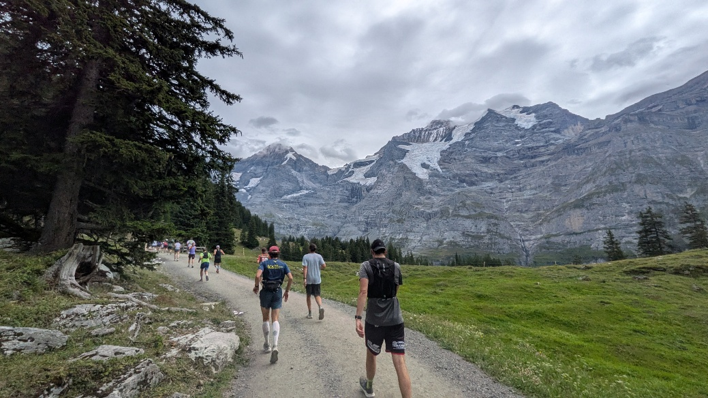
As the gravel roads relentlessly gained height, the views forwards and to the side were magnificent and constantly evolving. The finish at Eigergletscher station came into view, and when I passed the 37.25km flag, I was told by my faithful supporters that it was only a parkrun to go – but perhaps the toughest parkrun in history. I pressed on, mixing walking and running – with the mental challenge of breaking back into a run getting harder.
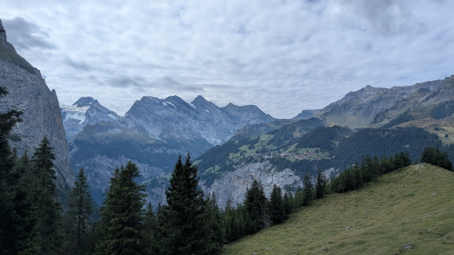
Only once did I wonder to myself “what am I doing here?” but apart from that I just pressed on regardless, drawing on seven months of dedicated training, from inner strength but also from the glorious surroundings, the shared experience with my fellow runners, and the unique experience thanks to WhatsApp and the reliability of Swiss 5G coverage of being able to share it with many others back at home.
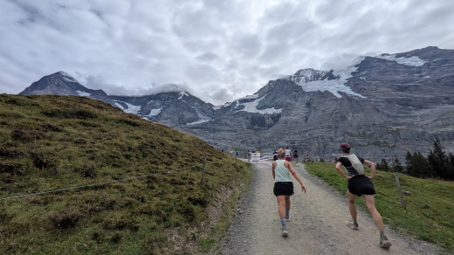
I reached the top of the climb on roads (1858m asl) some 25 minutes ahead of schedule, and at about 4h54 compared to the cut-off of 5h50. The downhill incorporating the last of the roads was a little longer (and steeper) than I’d mentally expected, and I would love to have been able to take full advantage of it, but I found it really quite tough as my right leg again rebelled twice over the course of a few hundred metres, producing more gasps and shrieks, but I managed some running on this precious easier section, but not at the pace I would have hoped.
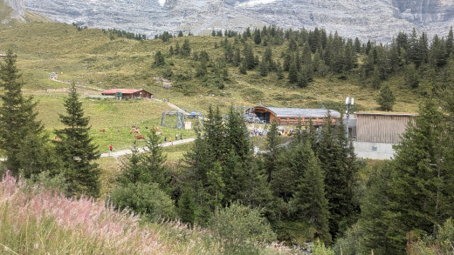
Nevertheless, from Wengen to Wixi, I dropped only 19 male places from 1737th to 1756th which with the cramps and the near-halt they caused me for a while, was a good outcome.
I had a somewhat elongated stop here at the aid station at the base of the Wixi chair-lift (1827m asl) to get as much fluid into me as I could, plus another salt capsule and some more banana, before embarking on the route as it moves away from the roads to the hiking trails. There was an “alternative” 1.3km route that had been opened as foreseen, for us in the middle of the pack when it gets very busy, but I’m not clear whether people were being directed onto it semi-randomly, as I never saw people diverging, and I just continued along the standard route.
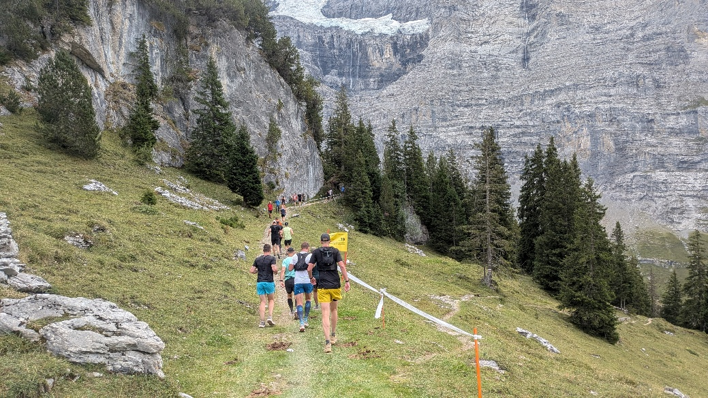
The race rounds a corner and heads across to a path on a ledge under a vertical cliff, with a rare handrail on a hiking trail, which tells its own tale, before continuing across rocks and tree-roots, slightly downhill before turning sharply left and uphill. This turn slightly discombobulated me, since I’d watched video of the race from last year, and thought I had a mental picture of key elements of the route, but this was totally unfamiliar, climbing up through woodland on a hiking path with steep steps up over rocks and more tree roots, proceeding as slowly as the slowest person in front, including one woman who was getting a hand up.
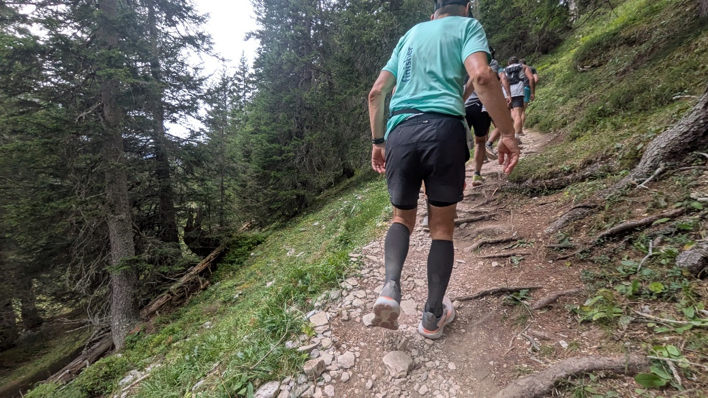
The terrain then opened up a little, but it was relentless uphill on very tough terrain with steep rocky steps up, making it very hard to maintain any pace at all, with the constant challenge of the people in front. Occasionally a wider section opened up or there was an alternative route for a few metres, but while I wanted to go faster than some people, I only wanted to go a little faster, and it was hard to push myself to get around them while I could, several times my heavy legs not lifting my feet high enough off the ground to avoid a stumble, thus in turn holding up someone behind me.
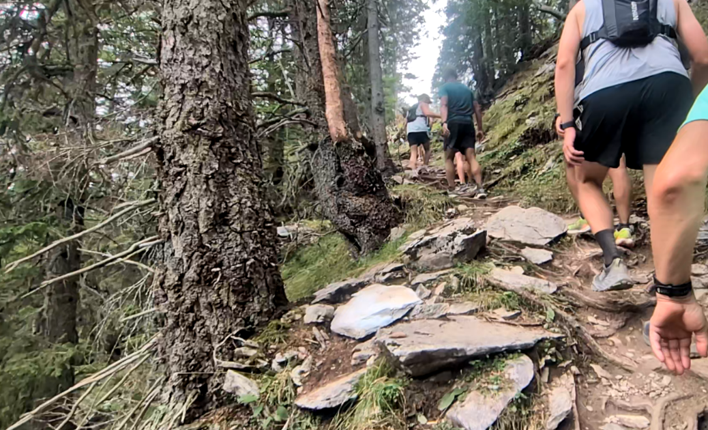
The gradient eased as we emerged onto a broad ridge with views of the Eiger, Mönch and Jungfrau, and the terrain became more akin to broken limestone pavement, interspersed with more tree roots and the occasional gorse bush, before it levelled out as we approached another aid station at Haaregg (1990m asl), at the coming together with the alternative route.
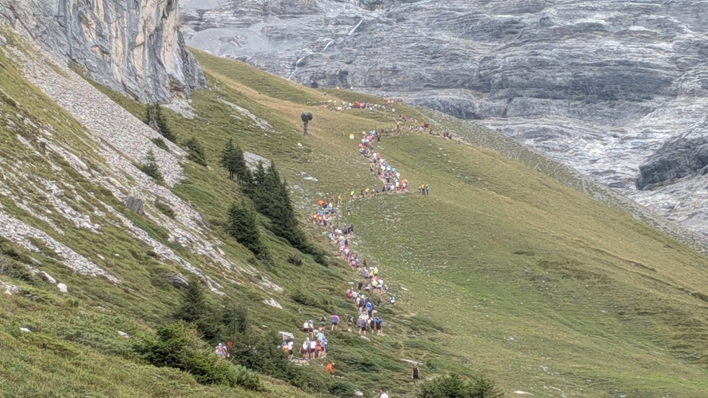
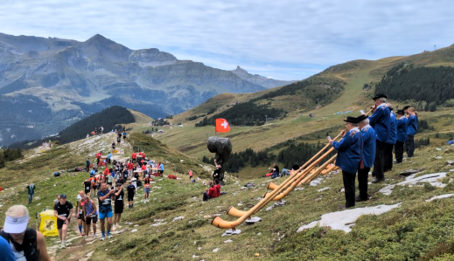
From here, snaking away across the hillside, was a seemingly unending stream of runners – well, walkers would be more accurate at this stage. I topped up with Iso, water and Coke, paused briefly to video the alphorn players and Swiss flag tossers, and pressed on – but not very far as we came to a halt, queueing for access to the path which was relentlessly single file, now with the people from both the standard and alternative routes merged.
Over the course of the section from Wixi to the finish, I dropped 69 male places. Some of these were in the slower than ideal descent from the Wixi cut-off, a few more in my slightly longer stop at the Wixi aid station, but I thought I passed as many as I was passed by on the ascents, so I reckon the “alternative” route, despite being billed as equivalent, may in practice have been a little easier (at this time today anyway – “easier” being in large part influenced by the number and capabilities of the runners present at the time). But maybe my attention was just so focussed on the essentials that I didn’t notice how many passed me, especially on the last kilometre or so where there was more space to do so.
With the combined effect of approaching the end of a challenging marathon, relentless steep uphill, tough underfoot conditions, intermittently cramping feet, a complaining left thigh muscle, a bruised right thigh muscle from cramps, and the slightly reduced oxygen from the altitude itself, I certainly didn’t want to be racing up the slope towards the glacial moraine, but I would have liked to have gone just a little quicker. Having seen video and photos of this section, I knew I was likely to be constrained a bit by others, but it didn’t stop it being slightly frustrating.
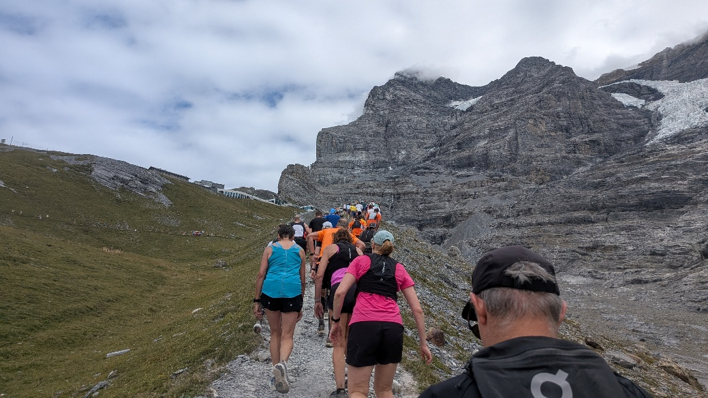
Eventually I emerged onto the path along the ridge of the moraine (2150m asl), and there was enough width to pass a few people, and more generally just to go at my own pace, including not holding up others either.
At the top of this, I was more than 30 minutes ahead of schedule according to my watch, and the prospect of a sub-six-hour finish suddenly seemed more real than when I’d passed first passed the six-hour pacer, before being re-passed by him during the worst of the cramping episode. I never saw him again after that during the race, so can only assume he went on the alternative route and I passed him before the contingents merged again. I did see him at the bag drop afterwards and was able to thank him and tell him how much of a thrill it had been to pass him, which in turn pleased him.
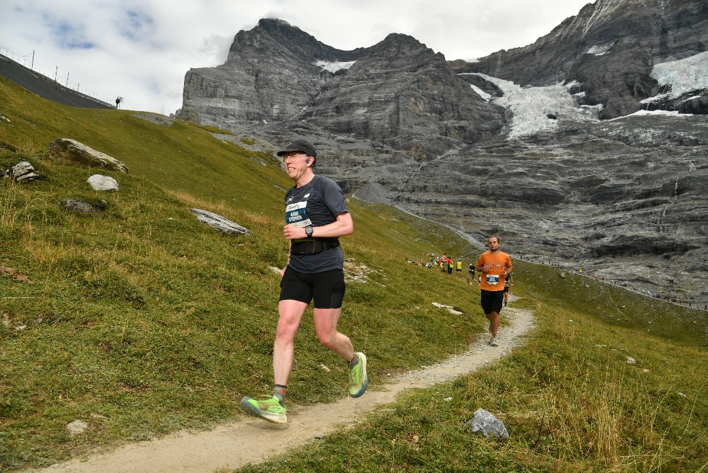
From the top of that moraine path (2207m asl), there is a short downhill – I had wondered how my legs would react, not least having seen a few of the elite runners in last year’s race wince as they took this section. What I hadn’t appreciated was quite how steep the initial section was, and it was a cautious first few metres before it became more easily runnable on tired legs. Myself and the woman in front of me broke into a run together (pictured here in an official photograph), but once again it was fellow participants who constrained us, choosing to walk on this precious gently downhill section, provoking a couple of rather hazardous overtaking manoeuvres right on the very edge of the narrow path, but allowing the running to continue a little further until the final aid station.
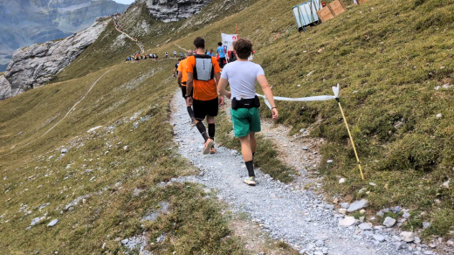
There was then a short uphill, squeezing around a few more people whose legs were doing worse than mine before a really awkward section which I christened, thinking of Alfred Wainwright on Crinkle Crags, the Bad Step – actually several very awkward steps over big sloping rocks on very tired legs, but with some wonderful helpers stationed there and holding out hands and arms for us to lean on as we stepped down onto a more sensible path.
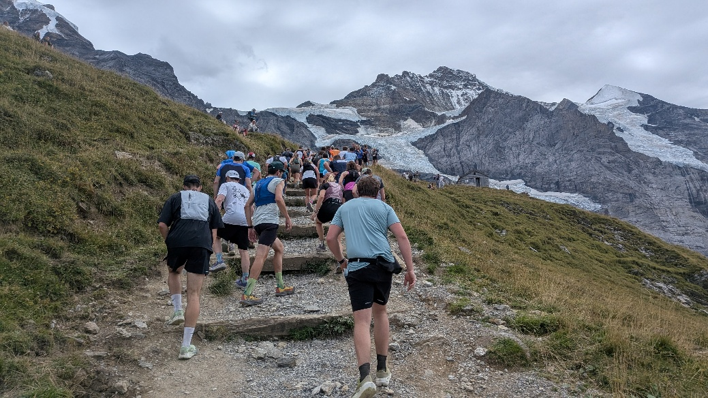
There was a short easy section on a path suddenly wide enough to feel like a motorway after the last three kilometres of narrow trails, before the steep ascent resumed, now steep enough that the path makers had installed broad steps. Those didn’t last too long before the turn towards Eigergletscher and the finish line, tantalisingly out of sight for what seemed like a long time.
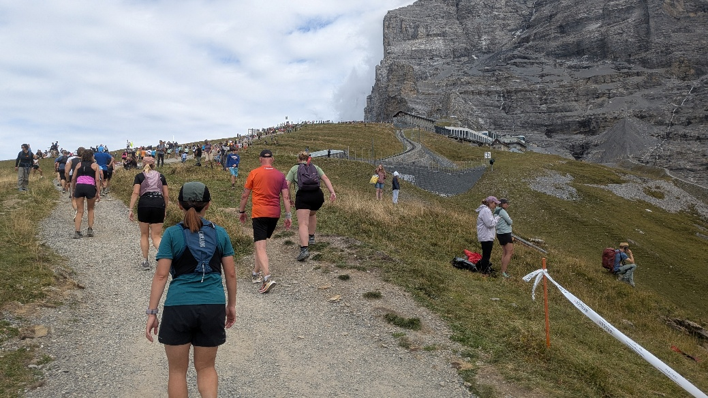
My watch continued to tell me that I was more than 30 minutes ahead of schedule, but the total time was moving relentlessly towards six hours, and my brain didn’t have the capacity to do any arithmetic to determine how many more minutes it would take me as I passed progress flags including the final 42km sign.
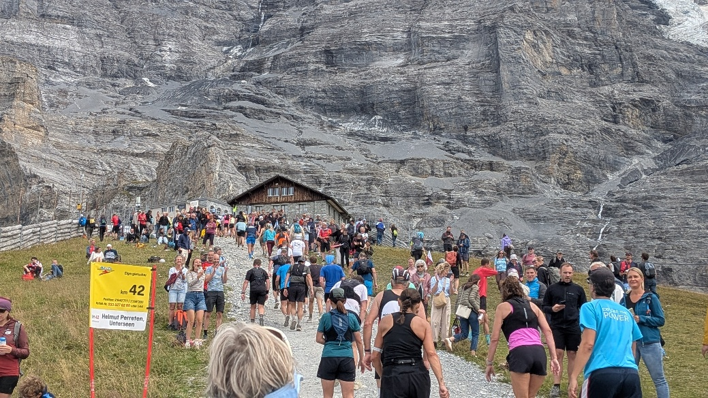
The crowds grew thicker, and I got the first “Stephen” and “Stefan” calls for a long while (reading my name next to my number pinned to my t-shirt), each of which I acknowledged with thumbs up. Suddenly the red carpet was there, on the final steep uphill, initially laid over uneven wooden slats (presumably primarily to make a smooth slope for skiers leaving the station area) which I’d expected, and then the red carpet is just on rough ground which was an unexpected additional hurdle as the finish line was so close, now risking stumbling on uneven ground concealed beneath the red. I kept going, and summoned the determination to break into a vague semblance of a run up the final 60 metres or so, past Dad, over the first timing mat, over the second one, and then stop. I turned to the finish arch and managed to pull out my phone to capture in LED lights “1823. Stephen Dawson 5:56:13,9”.


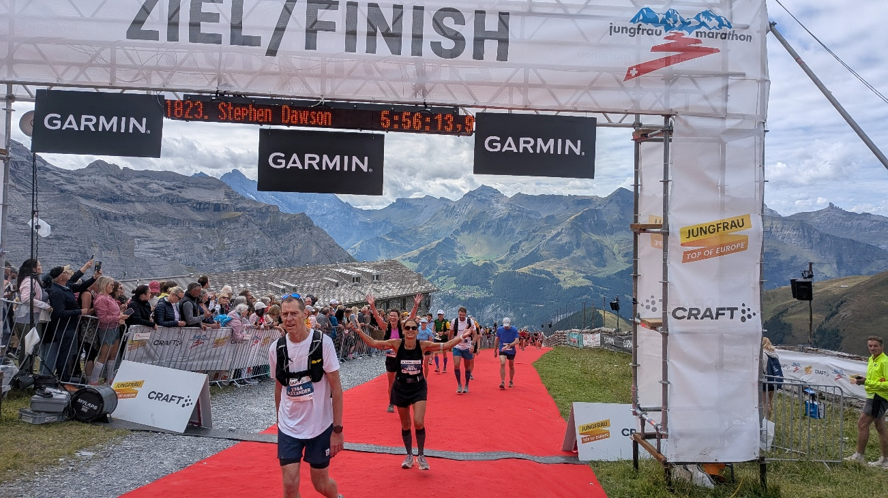
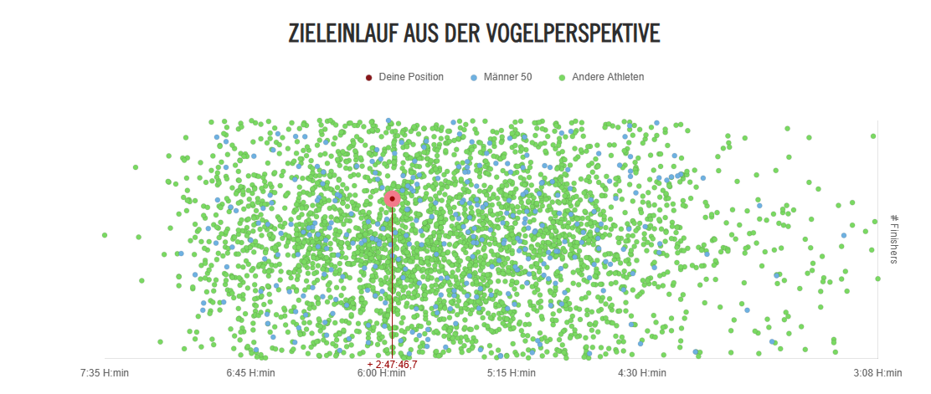
I’d done it. I’d finished, and almost 34 minutes ahead of my (admittedly deliberately conservative) time estimate, and apparently 1823rd – it turned out to be 1823rd man, retrospectively changed to 1824th and then to 1825th.
I staggered over to a barrier and leant on it, close to being overcome with both the effort overall and of the last bit of running over the line, and of the sudden release of emotion associated with it all. A first aider came over to me rather anxiously and encouraged me to breathe deeply to settle me down, and got me some water which after a couple of minutes I was composed enough to start sipping. After a couple more minutes I resumed my very tentative progress as my legs and feet said they’d really had enough.
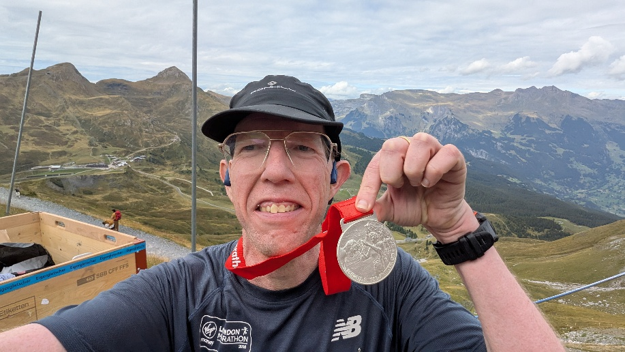
I claimed the precious medal, the possibly even more precious finisher’s t-shirt (the medal will get lost among many others, the t-shirt will get worn, and especially being a long-sleeved one, is one of only two such race t-shirts I have). I claimed my little Linzer Torte (which I later ate on the train – rather dry and not a patch on Lucy’s version) and my final portion of Jungfrau banana. Not interested in the offer of alcohol-free beer, I went to the bag area, where it wasn’t immediately evident what the procedure was for those of us with the large bags from the Lauterbrunnen valley, but I deduced they were at the far right end – later able to direct two fellow participants who hadn’t worked it out but who’d seen me with mine. I even found the presence of mind to take a selfie with the medal and the views stretching down the valley towards Grindelwald.
With some difficulty among the huge crowds Dad and I managed to meet up, and joined the queue to get away from the extremely busy Eigergletscher station. Some people were enjoying socialising and hot dogs (and the beer, both alcohol-free and possibly with alcohol too) but I just wanted to make progress towards Wengen. I had both of my recovery shakes from my big bag, and put on my finisher t-shirt, but didn’t bother with the other items of clothing I’d put in there – I guess if it had been colder (or raining) I would have been very glad of them. I deduced that most people were queueing for the Glacier Express cable car back to Grindelwald, which was both where most of the luggage was and the quickest way to Interlaken. For us, we wanted the train down to Kleine Scheidegg and we skipped the queue, soon getting on a train down, changing for another which took us back to Wengen.
Aftermath and reflections
My legs were initially very uneasy on the train down the mountain, and reluctant to let me sit down, but they soon recovered. I regularly suffer cramps in my feet after long races, but none at all this time. The minor tweak in my left thigh is still there a week later, but not causing any issues. The cramp bruising in my right thigh continued to be felt for a few days, but was only minor and didn’t stop me doing anything.
I ate well after the race, but had no GI issues. We did some gentle hiking the next day without problem, and on the following day I ran up the section to Allmend again, on fresher legs, and knocked 4 minutes off my intra-race time, and we continued to do some hiking for the rest of the holiday. All in all, I’ve rarely had so little post-race reaction from my body.
I clearly must reinforce with myself the need to keep popping the salt capsules throughout long runs, and probably to double-down on food intake too.
I was pleased with how well I coped with the uphill nature of the race, and could revisit a planned pacing plan on a future occasion – including probably making somewhat bigger allowance for difficult terrain and somewhat less allowance for elevation gain. Allowing for other people impeding progress is a very difficult thing to get right – and in this race I would have had to have been considerably faster for the crowds to be much thinner.
I’ve picked out at random several 50-54 Men who finished in 5½ hours, and I was still a fair bit faster than them up The Wall – was I too fast? Did it impact my abilities later on? Most of the difference between my 5h56 and their 5h30 was actually in the first 26km – was I too conservative? I can run a flat half-marathon (this wasn’t flat, of course, and a fair bit not on tarmac) 30 minutes faster than I ran the first 21.1km, and have run the first half of a full marathon 17 minutes faster than I did. Or was my easier start what left my legs fresh, allowing me to gain time on The Wall, and (without cramps) might have left me able to gain a little further time on the climb to Wixi? Things to reflect on if there is a next time.
I think it’s fair to describe this as the toughest run I’ve done, but hugely enjoyable and satisfying. The shared experience with the WhatsApp group was unique for me, and definitely added something new and fresh – not practical on faster, flatter races, but I’m well used to taking photos during ordinary runs, and used to frequent consultation of my watch, so it wasn’t a big extension from that perspective, and fitted well around a somewhat slower-paced run/walk. Thanks to everyone who supported and encouraged in any way on the day and in the lead-up to the race.
Would I do it again – yes, definitely, and I’d certainly consider other options such as that from Zermatt, but whether I will, and when, we shall have to see.
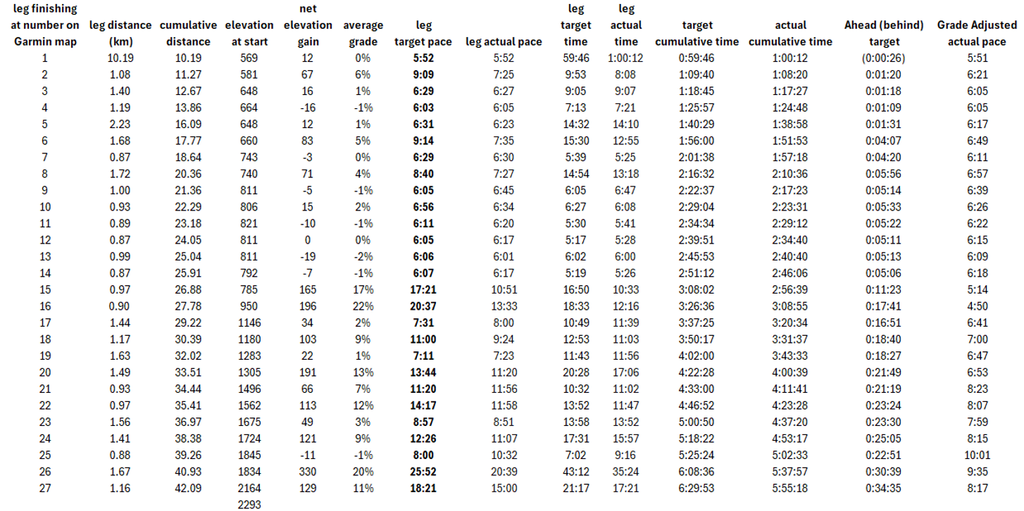
My PacePro plan and post-race comparison
Leave a Reply